Esther Mahlangu: A Solo Presentation in Los Angeles for the First Time
At the LA Art Show, Art of Contemporary Africa presents a solo online viewing room dedicated to Dr. Esther Mahlangu, marking the artist’s first solo presentation in Los Angeles. Bringing together paintings and vessels, the presentation offers a concentrated encounter with a practice that has shaped the global visibility of African abstraction while remaining grounded in lived knowledge, discipline, and continuity.
This viewing room introduces audiences to an artist whose work has circulated internationally for decades, yet has never been driven by novelty or reinvention. Instead, Mahlangu’s practice unfolds through sustained attention to form, surface, and colour, refined over a lifetime of making.
-
Sometimes the colours speak like a song, they speak together and it’s as if I am adding a melody with each brushstroke. Some people see it as spiritual but, to me, it’s about creating harmony with the colours, much like in music. I paint what is in my heart and what my heart tells me. I also paint what my brain tells me because I know it comes from deep down in the ancestral pools. When heart and mind agree, I know my spirit is in the right place. I paint to honour my ancestors! — Esther Mahlangu [ In Conversation: Thomas Girst, Azu Nwagbogu and Hans Ulrich Obrist, with Esther Mahlangu.]
-

An Introduction to Ndebele Painting as a Living Language
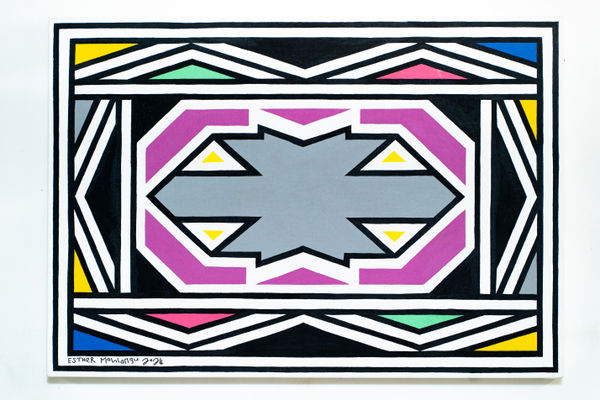
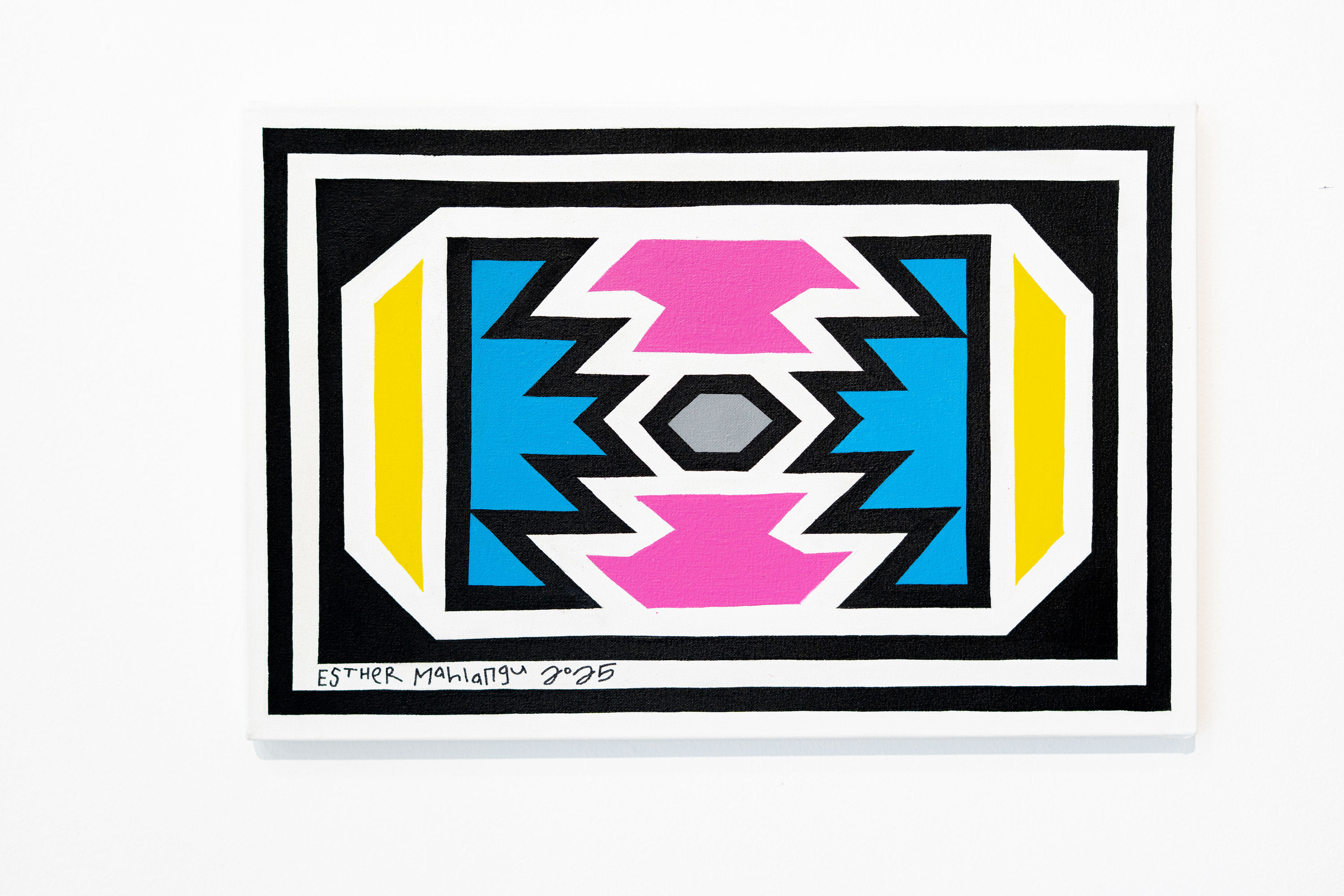
Ndebele mural painting developed as a visual system embedded in domestic architecture and social life. Painted primarily by women, the murals articulated identity, continuity, and cultural knowledge through geometric structure, linear clarity, and carefully balanced colour. These surfaces were not fixed statements, but living forms, renewed and adapted over time.
Dr. Esther Mahlangu learned this language as a child through observation and repetition. What distinguishes her contribution is the way she carried this system forward without freezing it in place. By translating mural painting from architectural walls onto canvas, panels, and sculptural objects, she extended its reach while preserving its internal logic.
What makes Mahlangu’s work so unique is that it is not a reproduction of tradition frozen in space but rather a dynamic methodology operating from within a tradition. Each painting reflects an inherited visual intelligence that has been tested, refined, and rearticulated through individual authorship.
-
Esther Mahlangu
Ndebele Abstract, 2025
Acrylic on Canvas
120cm x 120cm -
International Milestones and Achievements
Dr. Esther Mahlangu’s international visibility emerged early and has been sustained across decades. Her inclusion in the groundbreaking Magiciens de la Terre at the Centre Georges Pompidou in Paris in 1989 marked a turning point for the artist, situating her work within a landmark exhibition that reoriented global perspectives on contemporary art.
This was followed by participation in major biennales, including the Venice Biennale, the São Paulo Biennial, the Sydney Biennale, and the Johannesburg Biennale. Across these platforms, her work was presented not as cultural illustration, but as formally rigorous abstraction in dialogue with global contemporary practices.
-
-
Together, these milestones reflect a career defined by sustained relevance and institutional confidence rather than episodic recognition. Mahlangu’s work has not circulated through cycles of rediscovery or revision, but through continuous engagement at the highest levels of exhibition and collection. Museums have returned to her practice repeatedly, not to reassess its value, but to reaffirm it. This consistency signals a rare alignment between historical significance and contemporary vitality, positioning Mahlangu as an artist whose work has helped shape the very terms through which global abstraction is now understood. Her presence within major collections is not corrective or symbolic, but foundational, underscoring a practice that has earned its place through discipline, clarity, and enduring formal intelligence.
-
Teaching, Transmission, and Continuity
Alongside her studio practice, Mahlangu has remained deeply committed to teaching and mentorship. At her home, she has trained generations of young women in Ndebele painting techniques, passing on not only formal skills but cultural knowledge and discipline.
This transmission has practical as well as symbolic importance. By teaching a viable and respected artistic practice, Mahlangu has contributed to the economic independence of women in her community while ensuring the continuity of a visual language that might otherwise be diminished by global homogenisation. Her work demonstrates that continuity is not passive. It requires active engagement, responsibility, and care.
-
This solo presentation at the LA Art Show places Mahlangu’s work within a city shaped by conversations around identity, abstraction, and global cultural exchange. For Los Angeles audiences, the viewing room offers an opportunity to engage deeply with a practice that has long influenced international discourse, yet has not previously been presented here in solo form.
For collectors and institutions, the works presented represent a practice of exceptional longevity and integrity. Canonical yet active, grounded yet expansive, Mahlangu’s work occupies a rare position within contemporary art.
This viewing room invites attention rather than spectacle. It rewards sustained looking. It affirms the enduring power of a visual language refined across a lifetime.